Vercel · unsolicited concept · 2026
What will it cost? Or save?
Showing a Hobby developer their own last thirty days, priced as Pro — before they decide.
- Company
- Vercel
- Role
- Senior Product Designer, Growth
- Surface
- The Hobby → Pro upgrade modal
- Problem
- $20.20 is quoted to the cent. The metered tail behind it is one clause of prose.
- Move
- Price their own last 30 days as Pro, and set the ceiling inside the checkout
- Borrowed from the posting
- Success and guardrail measures — applied as formulas and a decision rule, not described
The decision nobody can price
Hobby is a bounded allotment. You cannot be billed. Pro is a meter — around forty billable resources, charged in arrears. The upgrade modal is the moment a developer swaps one for the other, and it quotes a single number.
The developer's real question is not what does Pro cost. It is what will Pro cost me — and Vercel is the only party in the transaction who can already answer it. The usage data is theirs. It is sitting in the account being upgraded.
They have already solved this once
One line in that same breakdown does exactly what the rest of the modal does not:
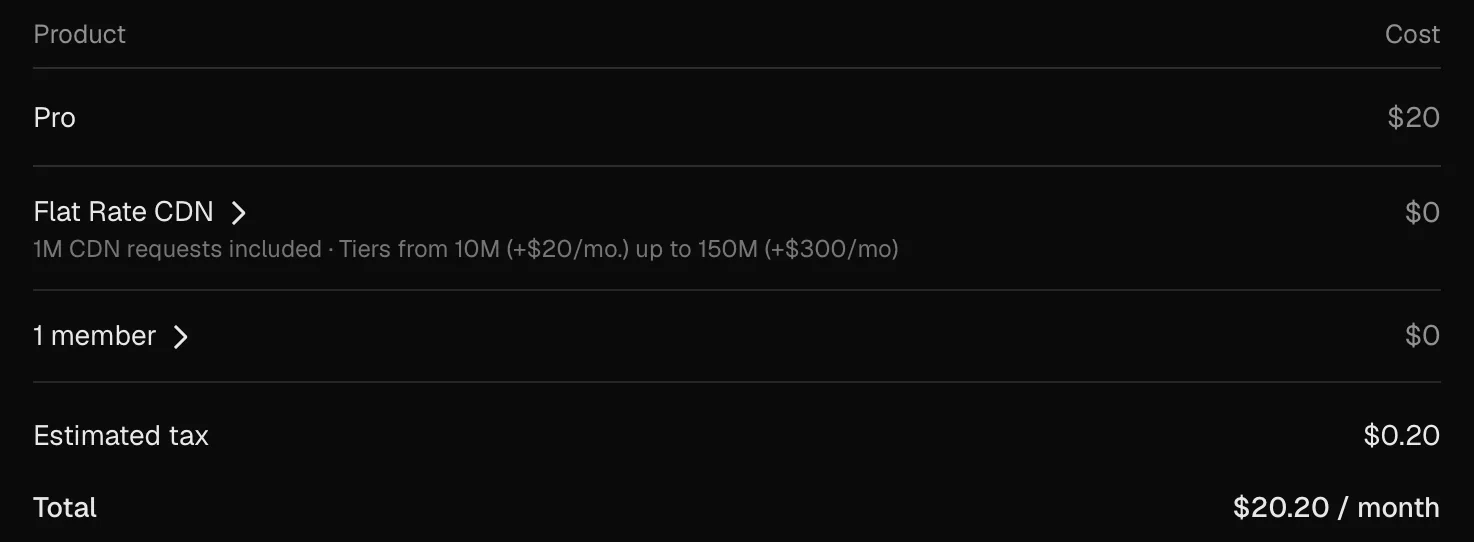
Flat Rate CDN is a meter that was turned into a visible ladder — what's included, where the next step is, what the top costs. It is in the checkout, in plain type, before the card is charged. Vercel built that pattern and shipped it.
Everything below extends that line to the other thirty-nine meters. It is not a new idea in their product. It is one they have only applied once.
Principles
- Price the past, not the future.A forecast is a promise you will be held to. Last month is a fact you already own.
- For most accounts the answer is reassuring.Silence reads as a warning. Staying quiet costs the upgrade that would have been easy.
- One number is a guess. Three are a decision.Charged today, a typical month, and a hard ceiling.
- The ceiling is set before the card is charged.Not as step three of a welcome tour the user is already clicking past.
- A cap must say what it costs you.If pausing takes the site offline, that sentence goes on the control, not in the docs.
The flow
Two accounts, the same four steps, opposite conclusions. Switch accounts or jump between steps at any point.
Steps 1 and 2 are new surfaces. Step 0 is a redraw of Vercel's live modal, kept to the same copy and layout so the additions can be judged against it.3
Why the cap is the second move and not the first
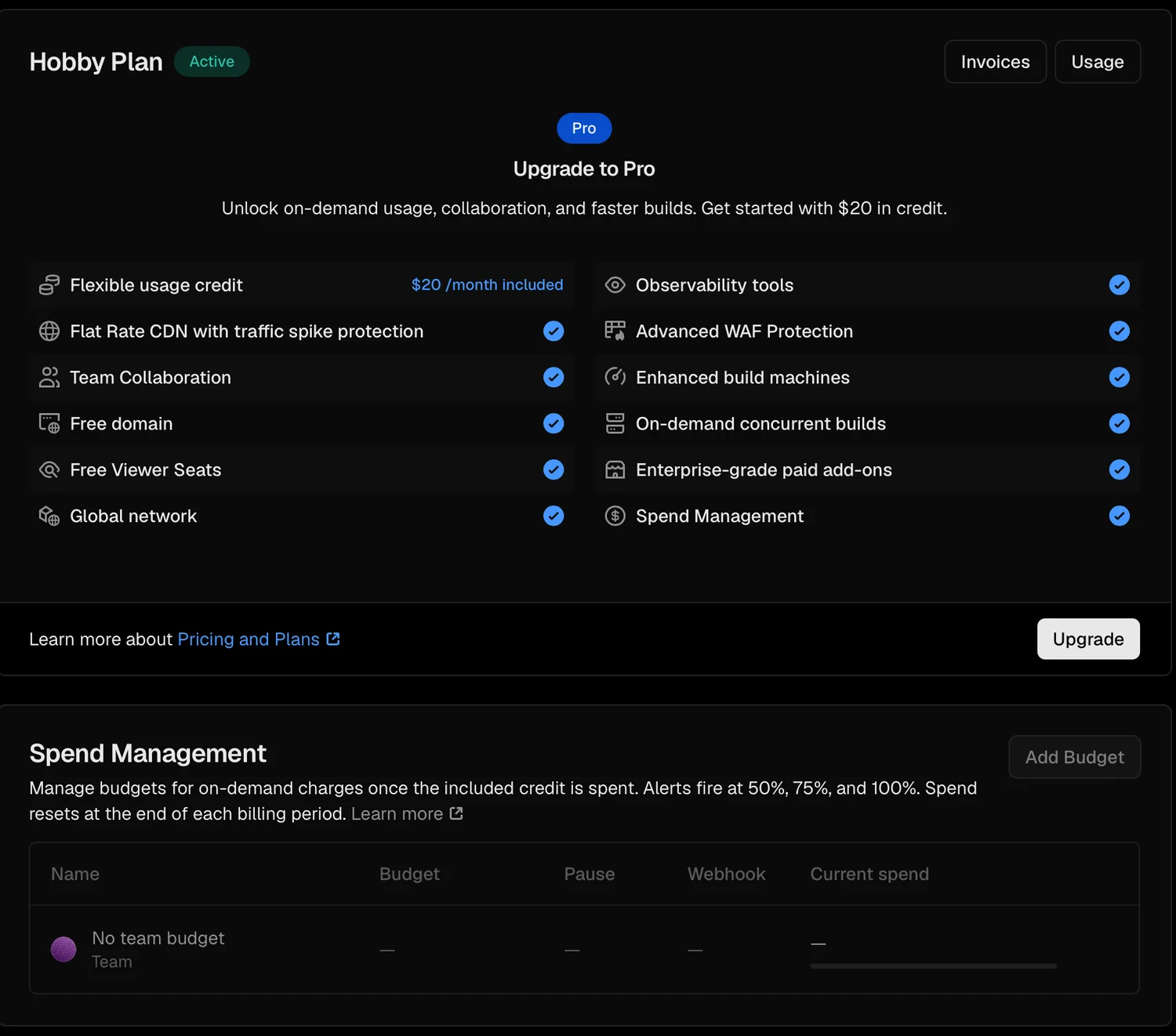
Spend Management already exists. It is listed as a Pro feature on the upgrade card, it renders on Hobby as an empty state you can look at but not use, and after you pay it appears as Next step 3 of 6, between claiming a domain and enforcing MFA.
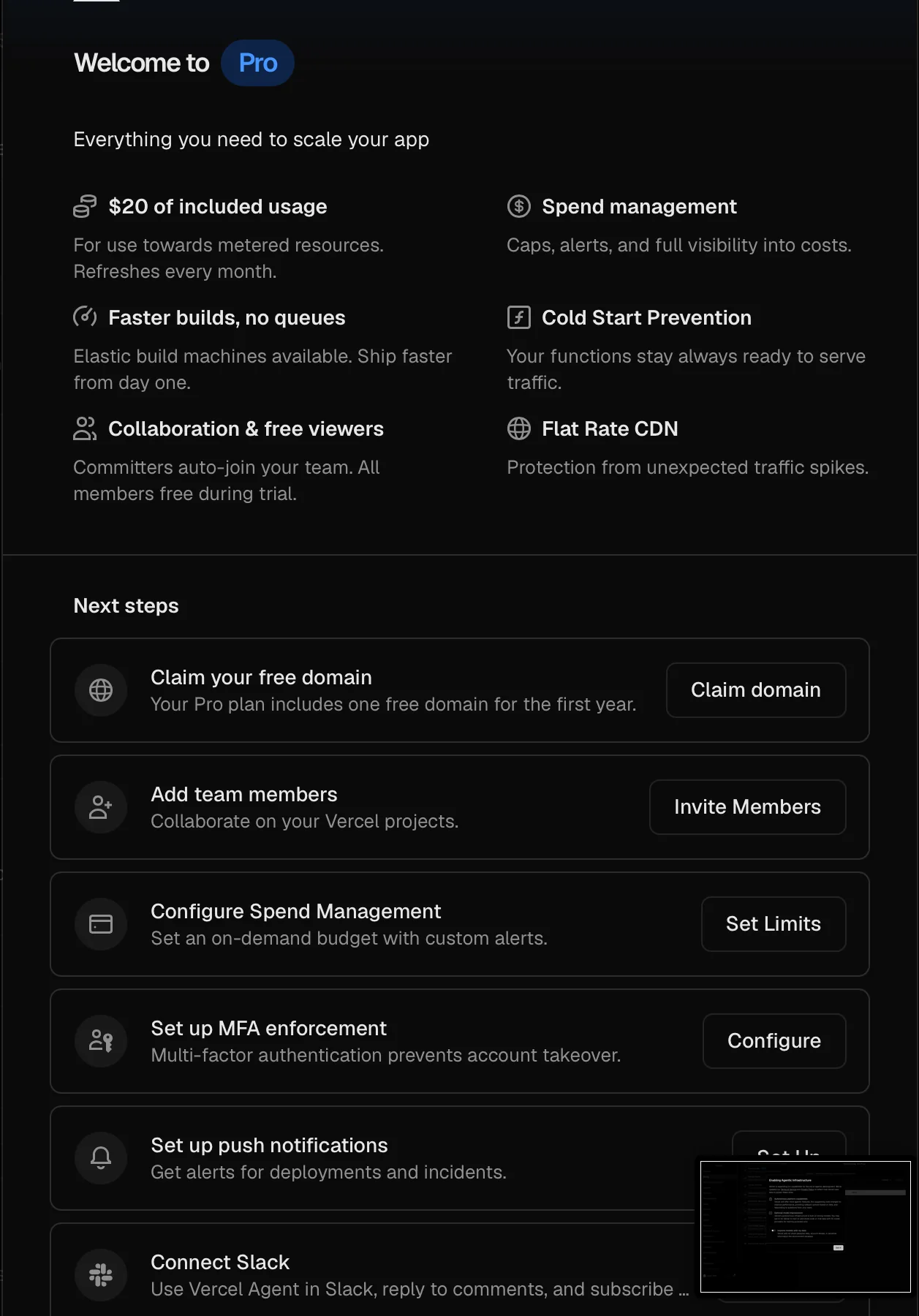
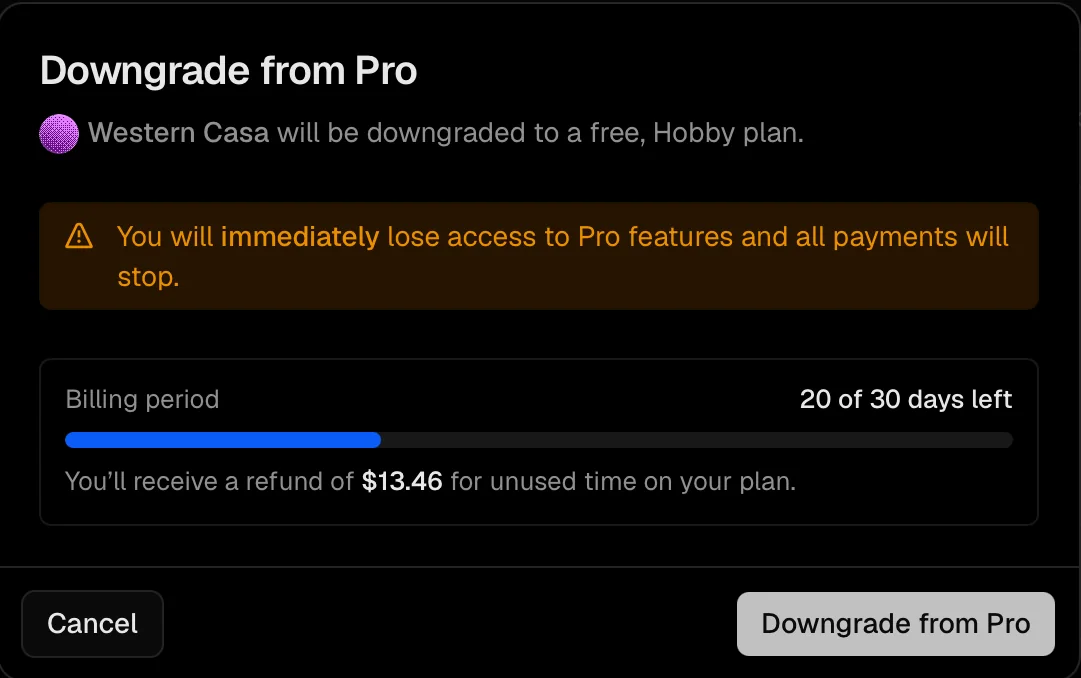
So the second half of this concept is not a feature. It is a sequencing change: the same control, two screens earlier, with a number already suggested for it. That is the cheapest thing on this page to build and probably the first thing I would ship.
How I would know it worked
The posting asks for someone who can form useful hypotheses and choose success and guardrail measures. That is the practice I took from it, so here it is applied rather than described.6
Hypothesis. What stalls the Hobby → Pro decision is not the $20. It is the unpriced tail behind “other metered features bill in arrears.”
The measures, written out
Day-60 Pro retention
Monthly cohort, against a holdout. Ship gate: ΔR₆₀ ≥ +3 pp
Conversion on its own can be bought by saying less, so it is the wrong thing to optimise against. Retention cannot be bought that way: if the retrospective is honest, the people it converts should still be there two months later.
Upgrade start rate
Hold: S ≥ 0.93 · S₀ (no worse than a 7% relative drop)
A real number can frighten someone off, and for the spiky account it probably should. But a large drop means the number is being presented badly, not that it should be hidden — so breaching this triggers a re-frame, not a rollback.
Billing-surprise rate
Hold: B ≤ B₀
If this rises, the estimate is being read as a promise. That is a copy failure with a real cost attached, and it is the failure mode I would expect this design to produce.
Band accuracy
Hold: A ≥ 0.80 · Kill: A < 0.60
The number that can end the feature. If last month does not predict next month for most accounts, the retrospective is theatre and it should come out rather than be tuned until it looks better.
The trade I would accept, stated in advance so it cannot be rationalised afterwards: fewer upgrade starts in exchange for higher day-60 retention is a win. Fewer starts and flat retention is a loss, and I would roll it back.
What is theirs and what is mine
Separated so nothing on this page can be mistaken for shipped work.
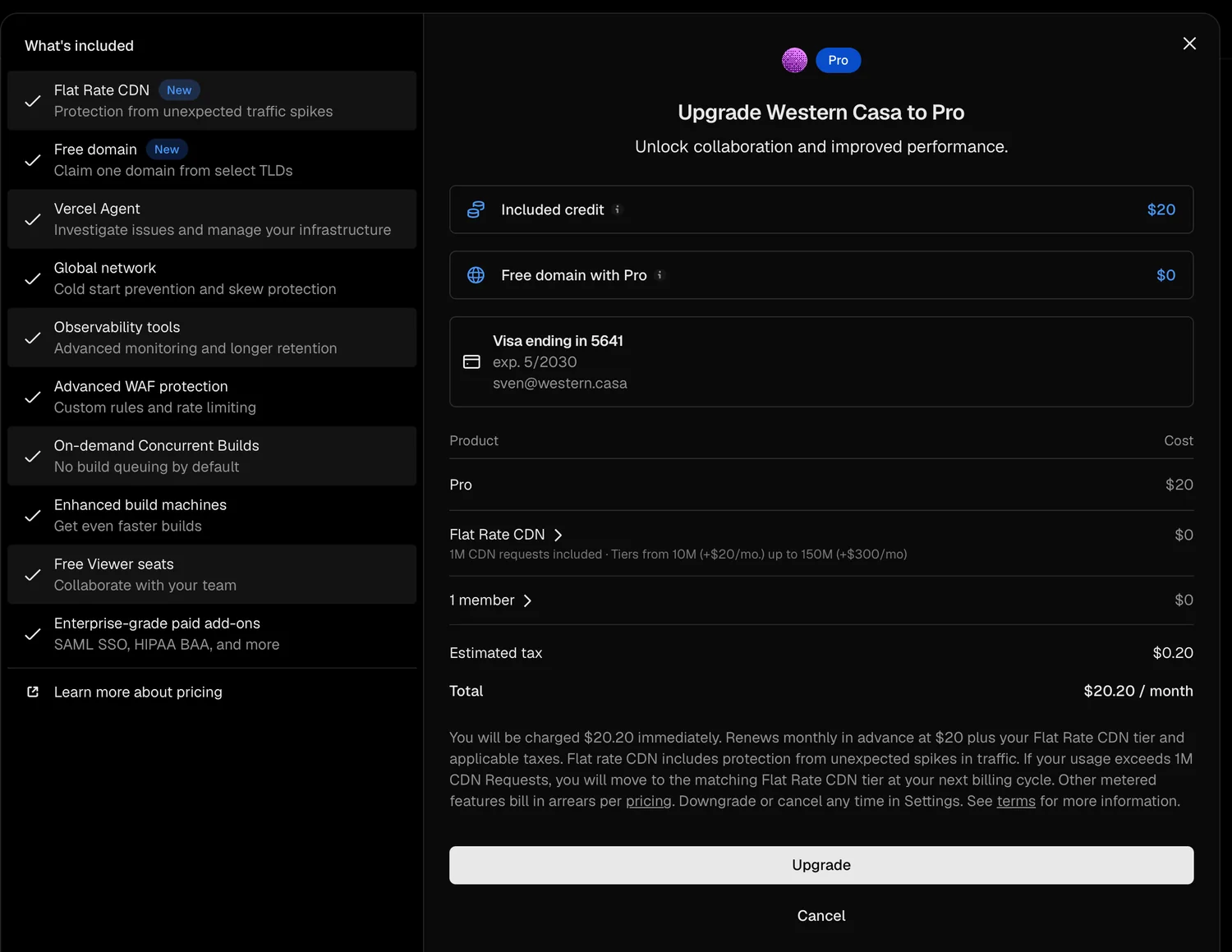

- The retrospective blockYour last 30 days of Hobby usage, re-priced on Pro's rate card, itemised by resource, with the included credit applied. New surface, new copy.
- The ceiling row inside checkoutSpend Management's existing control, moved into the upgrade modal with a suggested figure and the pause consequence written on the toggle.
- The three-number totalReplaces the single Total line with charged today, a typical month, and a ceiling.
- Both accounts, every figure, and all four measuresInvented to illustrate the two cases and to show the practice applied.1 Real per-unit prices are not quoted.3
What I could not work out from outside
- Does the Flat Rate CDN tier come back down?The modal says one spike moves you to the matching tier at the next billing cycle. It does not say whether a quiet month moves you back. If it does not, a single bad day changes the floor permanently — and that is the most important thing the upgrade modal is not saying.5
- How many Hobby accounts have enough history to price?A brand-new account has nothing to re-price, and that is probably a large share of the upgrade population. The empty state may matter more than the populated one. I would want the distribution before building either.
- Is the pause consequence survivable?“Your production deployments go offline” is the honest sentence. It may also be the sentence that makes nobody turn it on — in which case the cap is alerts only, and this design is half of what it claims.
- Where does the agent usage land?Vercel Agent is on the Pro feature list. Agent-driven consumption is the least predictable kind there is, which makes a ceiling more valuable and a retrospective less so. I do not know enough about how it meters to design for it.
Notes
- Every usage quantity, dollar amount, account and persona in the prototype is invented. Neither account is a real Vercel customer, and the four measures are my own proposal, not Vercel's. ↩
- Screenshots were captured from my own Vercel team account on 30 September 2026. The plan structure, pricing copy and interface are Vercel's. ↩
- Per-unit prices are not quoted. The prototype uses plausible round figures so that it does not misrepresent a rate card that changes. The arithmetic is internally consistent; the rates are not Vercel's. ↩
- “Other metered features bill in arrears per pricing” is quoted verbatim from the upgrade modal's legal paragraph. ↩
- Stated as an open question rather than a finding. I could not determine the behaviour from the product surfaces available to a Hobby or Pro account. ↩
- The posting asks for a designer who can “form useful hypotheses, choose success and guardrail measures.” I took that as the practice to borrow and applied it to this concept rather than writing about it. ↩
Sven Manzanarez · productdesign.digital · Concept work, not affiliated with Vercel. All trademarks belong to their owners.